


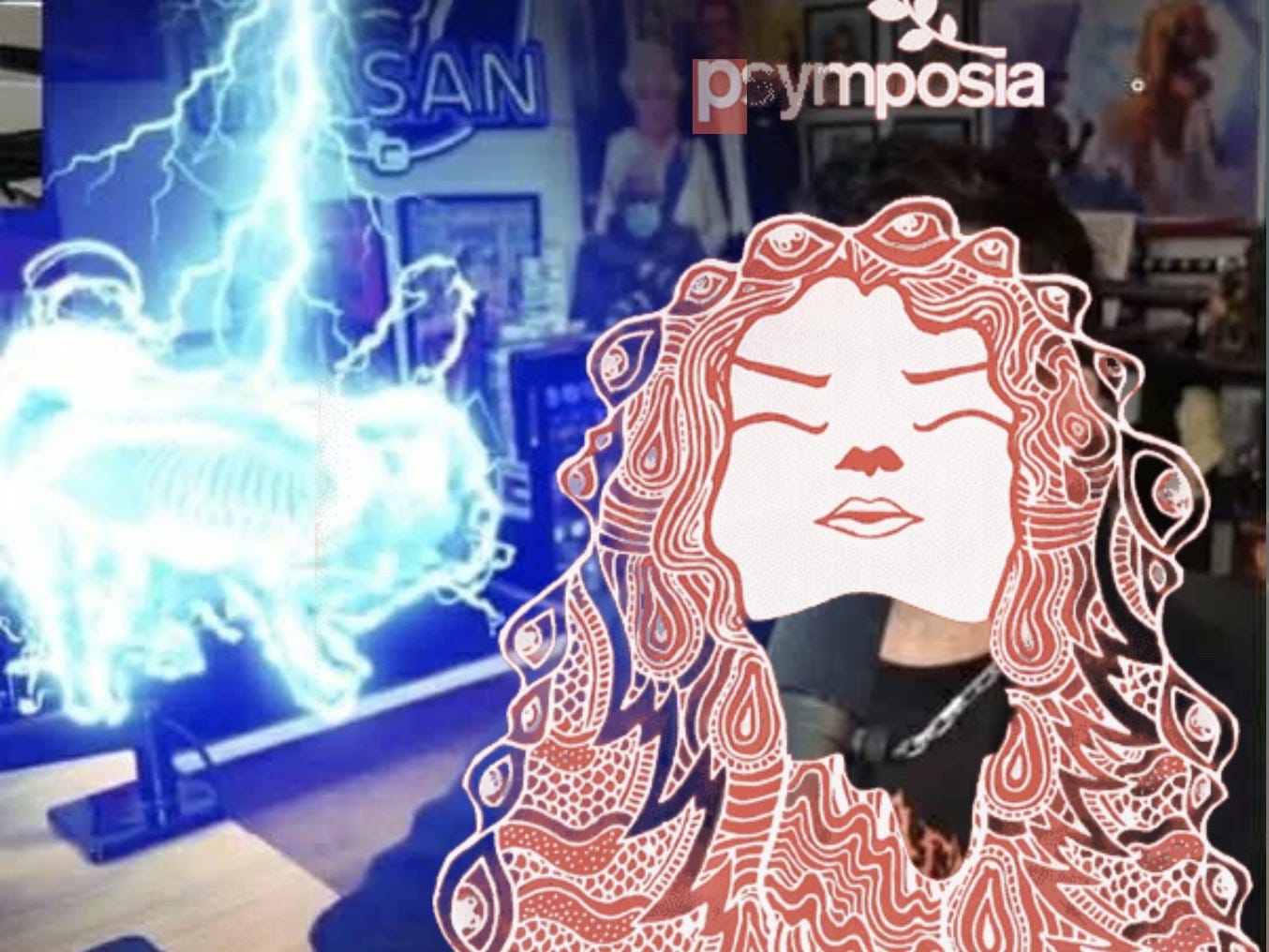
On September 27, 2025 — the week after Charlie Kirk’s assassination raised the temperature on violent rhetoric — a prominent YouTube channel released a conspiracy theory about my work and Psymposia that has since been viewed over 500,000 times on that platform alone.
In the two-hour video published by Channel 5 with Andrew Callaghan, psychedelic influencer Hamilton Morris described Psymposia as a leftist terrorist organization while Callaghan called on his audience to “destroy” us. This rhetoric was released into a context where the U.S. government had just identified “leftist terrorist” groups as legitimate targets.
Some commentators have equated Morris’ work of fiction with Psymposia’s recent investigative report, “The Psychedelic Syndicate,” where every claim was carefully vetted by a university-based legal team. Although I began this update intending to unpack how this false equivalence reflects the paucity of leftist perspectives in the “mainstream” psychedelic ecosystem, my writing ultimately led to something deeper and more systemic.
Morris’ actions are ultimately part of a broader psychedelic “alt-right pipeline” that has fueled the psychedelic ecosystem’s increasing right-wing orientation. This post is the first entry in a periodic series about this pipeline — how it functions to marginalize and isolate leftist perspectives, along with its significance for the broader online left.
In this first entry, I will explore how Morris’ treatment of Psymposia follows a playbook that has also been weaponized against the leftist streamer Hasan Piker. By outlining how this playbook functions, I hope to help establish theoretical foundations for a more networked and organized psychedelic left.
From my individual perspective, Piker’s perspective on his role as an educator applies equally to Psymposia: “We have a saying in our community, at least, that being a leftist is being right, just too early — and…you get punished for it.” In reference to the resulting retaliation, Piker insists that “All of these things that people throw my way are hurdles, certainly — but hurdles I can climb. Hurdles I can clear. Because at the end of the day, what I care about more than anything else, is moving…policy in a direction that…improves people’s lives. Uncompromising, unconditionally.”
At this time of rising fascism especially, I hope to draw on what I went through last year to help inoculate against the systems that make leftist communicators harder to comprehend.
“Shocktober 7th”
To begin with some background context, Hasan Piker’s work was a source of comfort and motivation for me last year, as I watched him navigate very similar challenges to my own: Ethan Klein — a former friend and collaborator — experienced a severe crash-out, during which he obsessively scapegoated Piker based on splitting dynamics (e.g., black-and-white thinking). In Klein’s fixation with bringing Piker to justice for escalating perceived wrongs, Klein began collaborating with Piker’s bad-faith enemies, selectively framing Piker’s actions in a manner that encouraged harassment and death threats. As Piker’s influence grew, The New York Times sought to discredit him with an editorial originally titled “How Radical Is Hasan Piker? The Twitch Star’s Flirtation With Violence.” And through it all, Piker remained focused on the real issues, like rising fascism and the genocide in Palestine. I took inspiration from his fortitude and steadfastness.
Developing in parallel to the antagonism against Piker, the pro-MAPS side of the psychedelic ecosystem cultivated an evil simulacrum of me and Psymposia, as crystalized in Morris’ conspiracy theory. Just as with Piker, this cultural fixation is based on a telephone game of dehumanization, and it is unrelated to my lived reality as an actual person.
In this section, I will explore how reactionary figures have propagated these dehumanizing narratives against Piker and Psymposia, drawing an analogy between the one-sided actions of Hamilton Morris and Piker’s lead antagonist, Destiny.
Destiny — a longtime political streamer who, earlier this year, advised IDF soldiers to stop filming their war crimes — has allegedly harbored a vendetta against Piker for many years, beginning long before Piker’s meteoric rise over the past year. As YouTuber Alex Lovell explained in a recent video essay, “Destiny and [former co-host] Dan Saltman have waged a full-scale information war, wielding their communities and resources to spread their anti-Hasan message across the internet.”
This information war reached national headlines in October, as Destiny and Saltman amplified false claims that Hasan abused his dog Kaya by shocking her with an electric collar during his livestream. As Novell noted, “That accusation led to over 25 major media articles covering the Hasan Piker dog collar drama. Destiny himself has made over 300 videos talking about Hasan on his YouTube channel, and that’s not even including livestreams.”
According to Saltman’s own account of “Collargate,” this accusation was not made in good faith. Describing Piker’s extended community, Saltman boasted: “I learn from them. Because they spent so much time fucking over Ethan Klein with saying his dog was fed cheese. And I was just like, you know what? That’s a good strategy. Let’s fucking do that.” (As context for Saltman’s words here, Ethan Klein acknowledged regularly feeding cheese to his dog who consequently died of chronic kidney failure. Piker did not weaponize this fact to target Ethan, however.)
This strategy’s effectiveness hinged on an out-of-context video clip, which appeared to provide “irrefutable evidence” of Piker’s use of a shock collar during his October 7 livestream. In the clip, Piker’s dog Kaya yelps after Piker reaches for something on his desk, and Piker seems to heartlessly ignore her pain.
Despite the clip’s appearances, however, Piker was reaching for a tin of tobacco pouches and focused on restoring streaming settings when Kaya momentarily clipped her foot. In contrast to Destiny’s narrative — which justified Piker’s harassment and marginalization — the fuller context humanizes Piker, who was managing a stressful technology issue while jetlagged. These circumstances align with accounts from people who know Piker, all of whom say that Kaya is thoroughly pampered and loved.
For people outside of Piker’s community — and especially among those who had already been radicalized against Piker by Destiny’s community — the clip succeeded at dehumanizing Piker, framing him as a hypocrite and fraud. Even among fellow content creators who did know (or should have known) better, some chose to distance themselves from Piker rather than get swept up in the hate campaign.
“Collargate” generated so much attention that even J.D. Vance, the U.S. Vice President, endorsed the false claim in an October podcast. Referring to the clip of Piker, Vance stated: “If you cause suffering in innocent animals, you’re probably the kind of person that doesn’t care about suffering in people as well.”
This coordinated mobilization of selectively framed video clips is part of a broader strategy to target prominent voices on the left, as tech journalist Taylor Lorenz has described in her newsletter, User Mag:
Lorenz: “Instead of video being used as a tool to debunk conspiracies, it’s increasingly used as a tool to validate them. In Piker’s case, this has meant that an endless stream of years old clips are being repackaged and miscontextualized in order to further a politically-driven hate campaign. The dozens of out of context video clips spreading on social media, racking up millions of views, have become a digital Rorschach test. […]
“The goal is to isolate a target, manufacture controversy, weaponize social platforms and the traditional media to spread lies, and orchestrate sustained, networked harassment with the eventual goal of making someone so controversial that they end up bankrupt and deplatformed.”

Novell similarly connects this strategy to broader online trends: “Building your online community up by going to war with other creators and their communities is something that’s incredibly commonplace these days. There’s a whole news, politics, and entertainment system in place, ready to be misused and exploited by guys like Destiny to stop progressive ideas from actually breaking through. But things are starting to change.”
Psymposia’s “Collargate”
The effectiveness of this tactic relies on a power asymmetry, as influencers pushing anti-leftist smear campaigns tend to have broader reach and garner more support from capital. The same principle applies to the psychedelic ecosystem.
Since many drug enthusiasts “grew up” with Hamilton’s Pharmacopeia on VICE — at a time when the topic of drugs was more heavily stigmatized than they are today — he has a large parasocial audience that’s primed to trust the things he says. This includes Psymposia’s own version of “Collargate”: the false claim that I lied to the FDA to torpedo Lykos’ MDMA-assisted therapy application, as supported by “caught in 4k” video evidence. From Channel 5 with Andrew Callaghan:
Hamilton Morris: The most notable instance was the kind of ringleader of Psymposia, at this point, claimed that a MAPS therapist named Veronika Gold had pinned down a patient while they screamed, ‘get your fucking hands off of me,’ but that she would not stop. [*cuts to video clip from my FDA testimony*] And I remember hearing this and thinking, this is crazy! I thought I knew about everything that was going on.... I never heard this woman’s name before. I hadn’t heard about any of this. And I look at [Neşe’s] citation for this claim, and it’s a book called Integral Psychedelic Therapy, with a chapter written by this therapist — but it’s not a MAPS trial, and it’s not MDMA, and the section that she’s describing is a patient who’s speaking to the memory of their father, saying, get your fucking hands off to the—
Andrew Callaghan: Oh, so a ghost?
Morris: Yeah, yeah, yeah.
Callaghan: So like, being pinned down by your dad’s ghost.
Morris: Well, actually the ‘pinned down’ thing was completely fabricated.
Callaghan: Oh, that sounds horrible. Or p-, potentially therapeutic! But it doesn’t sound like it was.
Morris: Yeah, so, this was insane to watch, and it was horrible. Like, you know, to me, this is just another chapter in the endless, moronic harassment campaign by this group of psychos. But for people like that woman, Veronika Gold, that’s like their life being just publicly humiliated in front of the FDA by some nutcase who has no qualms about destroying the reputation of a stranger if it serves this agenda of preventing the approval of MDMA.
Callaghan: And were they successful in preventing that?
Morris: The FDA ruled against it.
Callaghan: Holy shit. So, there’s no legal MDMA.
Morris: No. The FDA ruled against it.
Callaghan: Even despite the fact that the clinical trials were a success?
Morris: Yes. [...] Okay, I, I, I wanna give, I wanna give credit to them for doing this horrible, horrible thing. [...] Whenever you have something that is precarious, it doesn’t necessarily take all that much to shift the balance.
Despite Morris’ claims, however, Veronika Gold’s technique — which justified the use of therapist touch to physically reenact traumatic encounters while patients are in an altered state — was explicitly drawn from the MAPS therapy manual itself. The MAPS manual included provisions for relying on a “safe word” to engage in physical struggle with patients, which Gold’s case study emphasized.
(As I have chronicled in this substack, after Gold requested corrections on my American Journal of Bioethics commentary about this connection to MAPS’s clinical trials, the journal’s editorial board reviewed the evidence and decided in my favor. This vetting of my analysis, which occurred before Callaghan published his interview with Morris, was not included in Callaghan’s video.)

The Alt-Right Pipeline Playbook
Ultimately, Morris’ Channel 5 narrative employs the same tactics and rhetoric as Destiny’s anti-Hasan messaging:
1. Dehumanize prominent leftist voices as evil/psychopathic terrorists:
Hasan is a “psychopath”; his livestream is a “terrorist recruiting platform.”
Psymposia is a “group of psychos,” the “the gutter that collected the dregs of the psychedelic world,” an “extremist group of nutcases,” and “dangerously insane”; Psymposia is also a “terrorist organization” that “advised people to start engaging in terrorist tactics.”
2. Misleadingly frame video “evidence” to delegitimize the target and make the smear seem irrefutable:
Hasan electrocuted his dog for aesthetics.
Psymposia intentionally lied to the FDA to sabotage a proven therapy.
3. Incite the audience against the target:
Destiny, describing Hasan: “I honestly think you could perfectly justify attacking/killing Hasan IRL for statements like this.”
Callaghan, describing Psymposia: “What are we gonna do about these people? What’s the plan? How are we gonna take them down? What can the people of the world do, the 5Cast viewers, to destroy these bastards?”
These tactics are designed to isolate the target, with the ultimate aim of ensuring that engaging with leftist ideas becomes socially toxic.
In the Channel 5 video, multiple figures who had historically humanized our perspective got added to the smear. Morris acknowledged the rationale for doing so in an edit to an October 4 reddit post (originally published a mere seven days after the Channel 5 video aired, and three days before Piker’s “Collargate”). In the post, after walking back the video’s pivotal claim that the pharmaceutical company Usona funded Psymposia to sabotage rivals, Morris stressed that “Anyone who has supported or promoted their [Psymposia’s] work is totally untrustworthy.” (Note: Psymposia has never received any funding from Usona or any other pharmaceutical company.)
The tacit message is that anyone taking us seriously in the future will be putting themselves at risk of harassment.
The stakes: We need systemic literacy to survive fascism
The truth is that Psymposia is a threat to the psychedelic status quo, but not because we’re terrorists (which — to be emphatically clear — we’re not). We’re a threat because when we’re able to communicate in a shared space of humanizing context, we’re able to explain our perspective in a way that many people start to understand.
Ultimately, Piker is a threat to powerful interests for the same reason, as is clear when he describes his strategy for educating people about leftist ideas:
“It’s been very effective — and it’s been especially effective. If it wasn’t, then the right wing...wouldn’t be actively trying to make me into a toxic person that is irredeemable, and even go after my friends who...have nothing to do with politics at all. They do that so that I am isolated in general, because they realize that if I’m not isolated, and I have normal relationships with these other communities, then their fanbases will be much more charitable to my worldview. And God forbid, maybe change their perspective.”
Last semester, as I traveled around the world as an invited speaker, I saw this play out over and over again: When I’m actually able to talk to people and get past their initial assumptions about what I’m saying, they start to understand me.
It’s clear that the power players in this field don’t want us to be understood. Speaking personally as a leftist, that fact would make me want to read us.

Some people think I deserve the harassment I’ve received since 2024, believing that I do the same thing to the other side. But this is a misunderstanding of my writing that reflects an unfamiliarity with systemic critique and leftist analysis. (“Critique is not harassment,” as I have explained before.)

In my work, I focus on systems of power and their externalities — not on the interior worlds of oligarchs, or their many good intentions. When I write about the actions of the powerful, my critique is unrelated to their experiences of themselves as actual people. Fundamentally, it isn’t personal.
When I analyze the elite capture of psychedelics, my methodologies are rooted in established academic discourses. I draw on studies of commercial determinants of health and the sociology of health inequality, where scholars have non-controversially argued that health inequities are maintained by elite class self-interest. In psychedelics as in the AI industry, the ruling class is actively pitching their class ideals as beneficial to us all. In both of these industries, however, there are “fundamental misalignments between elite class interests and public health.” In the interest of public health, it’s important to highlight how these developing industries are unnecessarily putting the most vulnerable at risk of harm.
As a core quality of this systemic orientation, I do not believe in good and bad people; we are all shaped by the obstacles and affordances of our circumstances. On this level of analysis, rendering harmful systems legible is an act of service. The less powerful are not mere sacrifices in the name of some more worthy cause.
Organizing to address the blind spots of the powerful is a collective responsibility — an ethic of collective care that is incompatible with dehumanization.
Moving forward, the psychedelic left is going to need to become more networked and organized. We need to build our own spaces and discourses, where leftist values are shared rather than demonized. And from such spaces, we can develop the capacity to better support one another — whenever the psychedelic alt-right pipeline comes for the next of us.
In solidarity and with gratitude for your support,
~Neşe
Something is deeply, deeply wrong with you, Nese. I pray you find the help that you need.
if an insistence on political ideology and partisan framing is more important to Psymposia than providing useful input into psychedelics research, the organization should just disband.
Psychedelic experience is ultimately individual, and that's a perspective that requires personal responsibility from the jump. To the extent that it gets politically coded, it's practically always related to reactive opposition at any attempts at outside control of the experience, from whatever ideological sector or partisan faction. Whether the political initiative seeks to ban all access to the experience by coercive arbiters of social morality, or attempts to direct the experience in some supposedly correct political direction by an ideological faction.
Everything in human existence should not revolve around Politics, which requires the existence of conflict between group interests. But for any group determined to infuse psychedelics use with a Political aspect in any way whatsoever, I think it's inevitable that individuals who use psychedelics will shift their politics in a Libertarian direction. As a matter of defense of the individual prerogative.
So perhaps Psymposia should find a mission more helpful to attaining positive long-term outcomes for psychedelics users. If they can find one.